The card sleeve, and the case against leather lining
A card sleeve is the object you handle most and think about least. It comes out four or five times a day, in front of people, in good light. It is the smallest thing we make and the hardest one to get right.
Most of the difficulty is in one decision: what the inside is made of.
The problem with leather lining
The default answer in this category is leather on leather. It sounds correct, it costs more, and it is worse.
Leather against leather grips. A card pushed into a leather-lined slot meets friction that increases as the piece ages and the surfaces polish against each other. Within a year the sleeve has developed a personality: two cards come out easily, one does not, and there is a specific one you have to fish for while somebody waits.
Leather-lined slots also stretch. Full-grain leather is a fibre structure under tension; asked to flex several thousand times a year at exactly the same fold, it takes a permanent set. A sleeve that held four cards firmly at the start holds four cards loosely by the end, and there is nothing to be done about it.
And leather transfers. A dark lining against a pale card, over a summer, in a pocket, is a mark you will notice on somebody's business card before you notice it on your own.
Why Alcantara instead
Every Elemento card sleeve is lined in Alcantara, and the reasons are the same ones that make it right inside a watch case — they simply matter more at this scale, because the object is used a hundred times more often.
It has the right coefficient of friction. Enough grip that nothing slides out in a pocket. Little enough that a card draws out cleanly with one thumb, in one motion, the same way on day one and on day five hundred. This is the entire brief for a card sleeve and almost nothing else meets it.
It recovers. The nap compresses under a card and lifts again. That is why the slot still holds three cards properly after a year rather than four loosely.
It does not transfer. No dye migration onto card stock, no matter how warm the pocket gets.
It is thin. A leather lining adds bulk to an object whose whole argument is that it does not add bulk. Alcantara adds almost nothing, which is how a sleeve holding four cards still disappears into a jacket.
It is also, and this is not a small thing, matte. Open a card sleeve and the interior returns no light at all. The cards are the only thing you see.
Why Pepita on the outside
The exterior is the opposite problem. It is on show, it gets handled with whatever is on your hands, and it lives in a pocket next to keys.
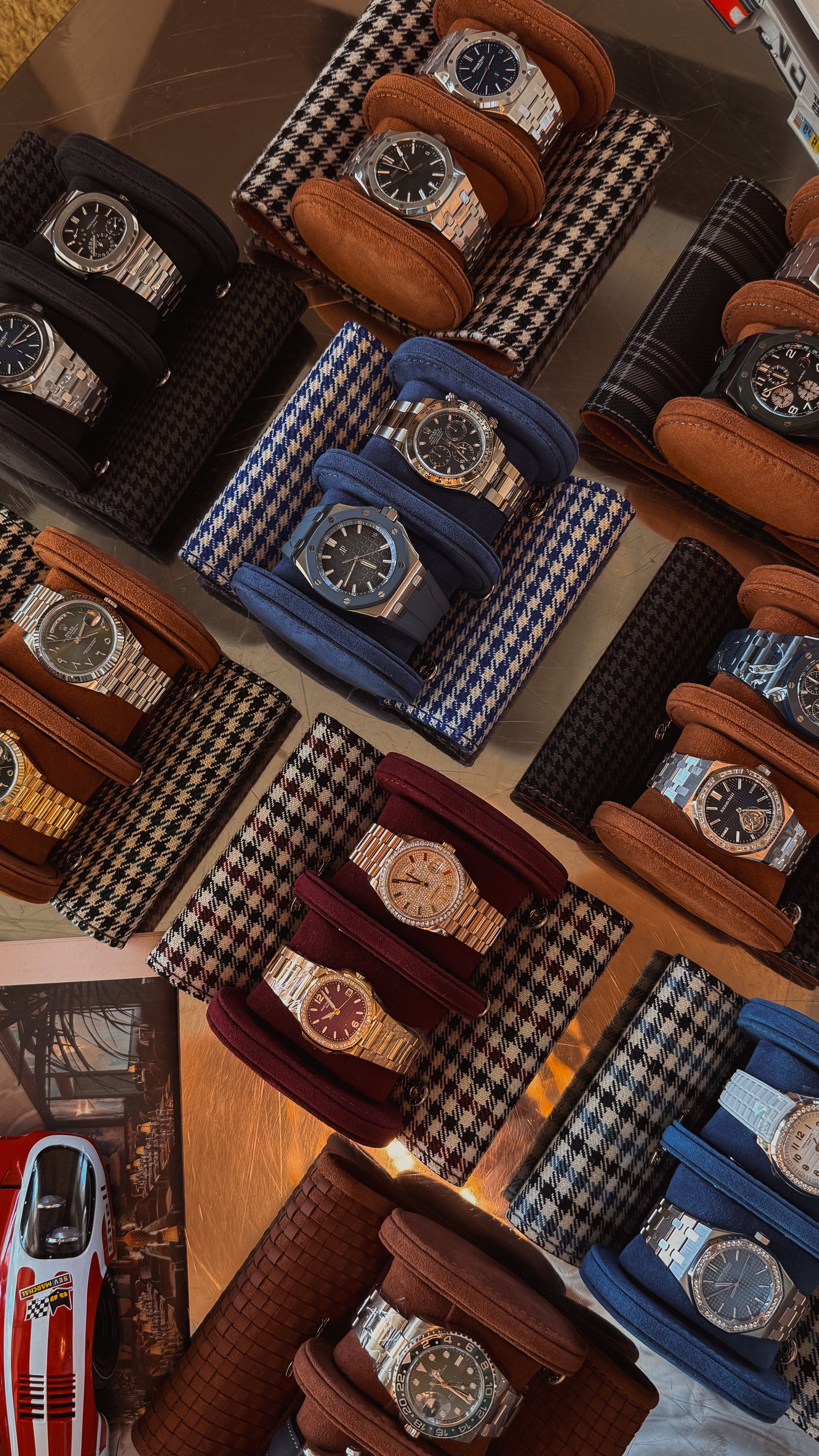
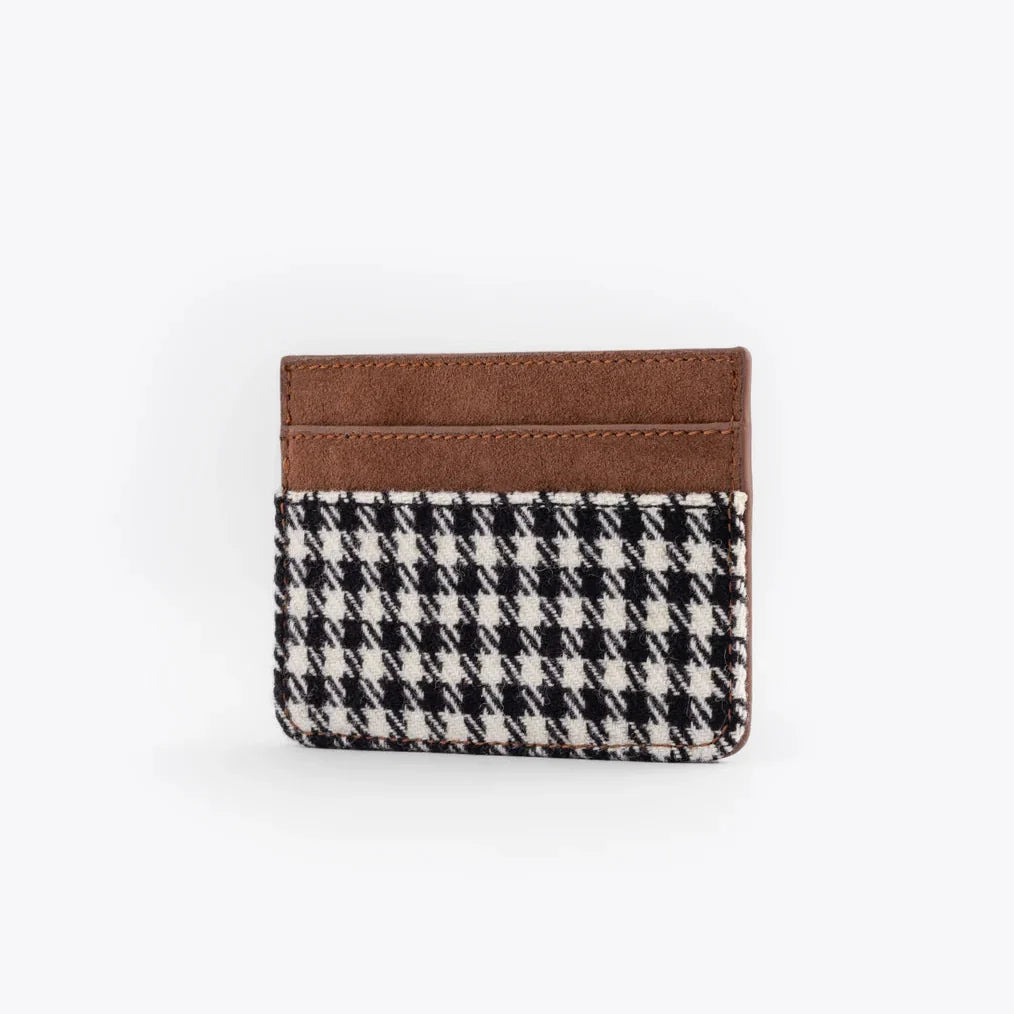
Pepita — the dense houndstooth woven for European automotive interiors — solves all three at once, and it does so for reasons that have nothing to do with how it looks.
There is no smooth surface to scuff, so it does not scuff. The two-tone tooth breaks up light before your eye can resolve a mark, so handling does not show. The weave was specified to survive decades of body oils, friction and sunlight through a windscreen; a jacket pocket is not a serious test.
And then, separately, it looks like nothing else. A black-and-ivory Pepita card sleeve drawn out at a table is recognisable at three metres by anybody who has ever sat in the right car. That was not the reason we chose it, but we would be lying if we said we minded.
The combination
Pepita outside, Alcantara inside, and a leather trim only where the object needs structure. Three materials, each doing the one thing it is best at, and none of them chosen because it was the expensive option.
We hold the sleeve in twelve colourways now — Nero, Cognac, Bordeaux, Rosso, Prugna, Verde, Blu Notte, Cioccolato, Tabacco, Nero Grigio, Blue and Burgundy. The construction is identical across all of them; only the temperature changes.
Initials
Any sleeve can be debossed with up to three initials, blind or in foil, at the corner. It is the one piece where we would gently argue for it: a card sleeve is the object most likely to be left on a table, and a marked one comes back.