



CARE GUIDE
How to live with Togo leather, Nappa, Alcantara and Pepita.
CARE
Living with an Elemento piece
Four materials leave the Maison: Togo-grain leather, Nappa, Alcantara and Pepita. Each ages differently, and each asks for something slightly different. None of them asks for much.
01 — LEATHER
Togo-grain leather
A full-grain calfskin with a raised, pebbled grain. It is the most forgiving surface we work with: the grain scatters light, so scuffs and fingerprints disappear into the texture rather than sitting on top of it. It is specified on pieces that live in a pocket or a bag.
Every day
Wipe with a dry, soft cloth. That is genuinely all it needs.
Every few months
A neutral, colourless leather cream worked in with a cloth and buffed off after ten minutes. Sparingly — Togo grain does not want to be fed heavily, and too much cream flattens the pebble.
If it gets wet
Blot, do not rub. Let it dry away from heat and sunlight, flat and unweighted. Never a hairdryer or a radiator; heat sets a water line permanently.
Never
Solvents, alcohol, baby wipes, saddle soap or silicone-based protectors. Any of them will strip the finish.
02 — LEATHER
Nappa leather
Fine, close-grained and soft in the hand. Nappa is the quieter leather and the less forgiving one: because the surface is smooth, it records what happens to it. That is the point. A Nappa piece three years in is a document of where it has been.
Every day
A dry microfibre cloth, light pressure, in one direction.
Every few months
A colourless cream conditioner, applied thinly with a cloth, left ten minutes, buffed. This keeps the hand supple and slows the appearance of dry creasing at fold points.
If it gets wet
Blot immediately with an absorbent cloth and dry in open air. Nappa darkens where it takes water and usually returns as it dries; rubbing it while wet will not.
Never
Do not store a Nappa piece in a sealed plastic bag, and do not leave it on a car dashboard or a sunlit shelf. Sunlight is the only thing that permanently changes the colour.
03 — INTERIOR
Alcantara
The interior of nearly every Elemento piece. A microfibre with a suede-like nap that recovers rather than crushes — which is why a watch left in the same slot for a season lifts out without leaving a shadow. More on the material.
Every day
Lift dust with a soft brush, working along the nap in one direction. A short blast of dry air is equally good.
A mark
A cloth barely damp with cold water, light circular motion, then dry in open air and brush the pile back the way it runs. Work from the outside of the mark inwards.
Something oily
A single drop of pH-neutral soap in cold water, same method, then a second pass with clean water to lift the residue. Do not saturate.
Never
No solvents, no alcohol, no wax, no leather conditioner, no heat. Alcantara does not need to be fed, and anything oily will mat the nap permanently.
04 — TEXTILE
Pepita
The house textile — a dense houndstooth woven for European automotive interiors, which is to say woven for forty years of sunlight, friction and body weight. On our pieces it does considerably less work than it was built for.
Every day
A soft brush across the weave, or a lint roller. Dust sits on the surface of a Pepita rather than in it.
A mark
Cold water on a barely damp cloth, blotted — never scrubbed. Scrubbing lifts the fine white yarns of the tooth and leaves a fuzzed patch that will not lie back down.
Something oily
Blot the excess first, then a drop of pH-neutral soap in cold water, blotted, then clean water. Let it dry fully in open air before the piece is closed.
Never
No bleach, no solvent, no machine wash, no iron. Do not use a stiff brush on the weave.
Whatever the material
Store it out of the light
Sunlight is the single most destructive thing an object like this meets. A shelf, a drawer, the dust bag it arrived in — any of them.
Let it breathe
Never a sealed plastic bag. Leather and textile both need to exchange air, and trapped moisture is how a lining goes wrong.
Empty it before it travels
Overfilling a case is what stretches a seam. Carry what the piece was cut to hold.
Ask us first
If something has happened that this page does not cover, write before you try to fix it. Most damage we see was caused by the repair, not the accident.
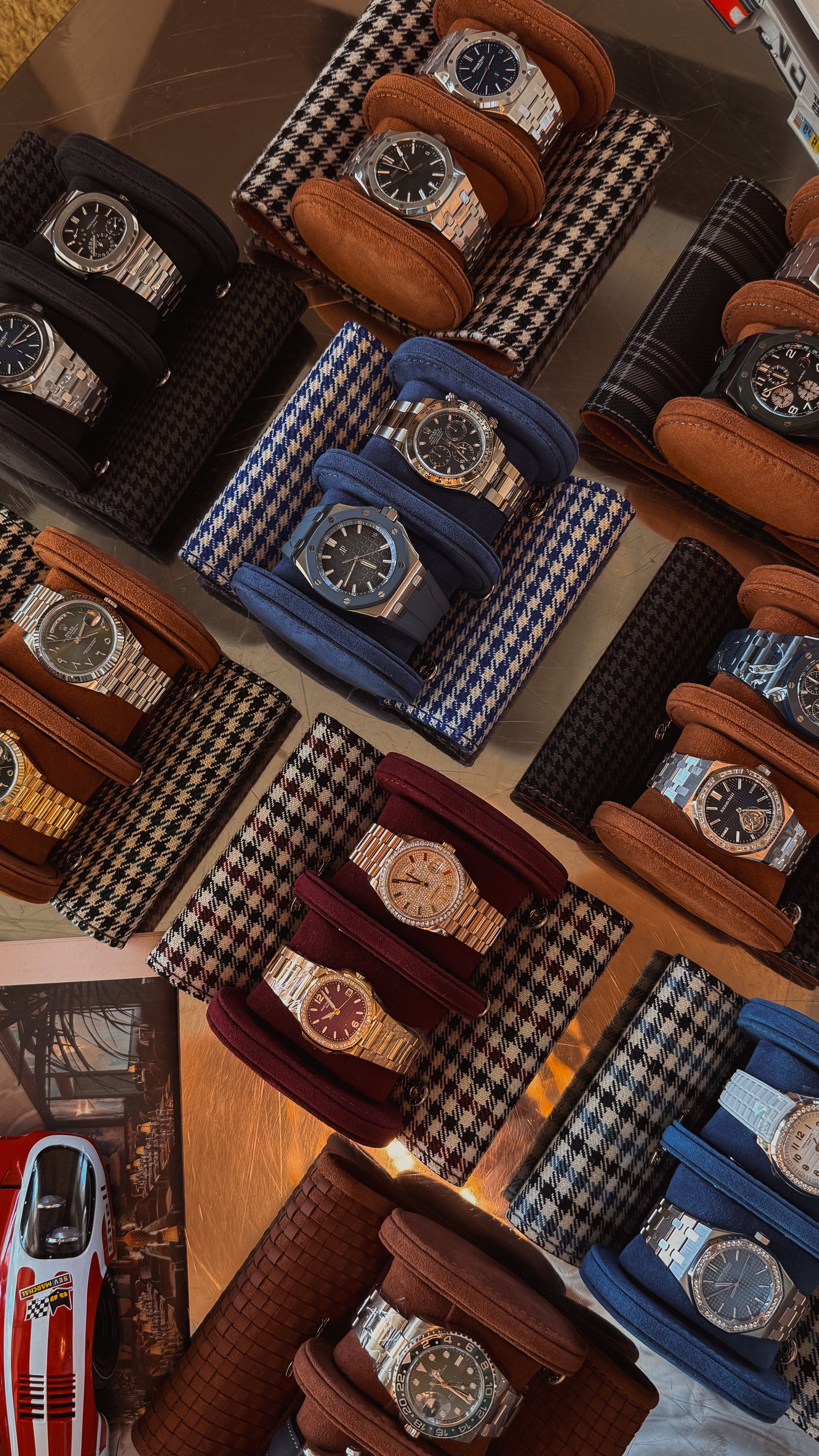
A COLLECTION IS A SEQUENCE
Few people buy a second watch. Most buy a third, then a fourth, and find the difficulty is no longer choosing but keeping. A trunk is not storage. It is the order you impose on the sequence.

TRAVEL WATCH CASE

Always within reach
Visit us in store
The Edition Space, Dubai Hills Mall — open daily, 10:00 to midnight
Find the store