Article: Why a collector eventually buys a watch roll
Why a collector eventually buys a watch roll
Nobody buys a watch roll first. They buy the watch, then the second watch, then a strap for the second watch, and then — somewhere around the third or fourth trip — they learn the lesson that makes the roll obvious.
It is usually a small lesson. A hairline on a polished lug that was not there when the bag was packed. A deployant that opened inside a wash bag and pressed itself into a sapphire for six hours at 38,000 feet. A steel bracelet that spent a weekend against a titanium case back and left a mark on it that no amount of light will now hide.
None of it is catastrophic. That is precisely why it is instructive. A watch is not usually destroyed in transit; it is quietly worn down in transit, one journey at a time, in ways that are individually forgivable and cumulatively expensive.
What actually happens in a bag
Three things, in roughly this order.
Watches touch each other. Two watches in the same pocket are two hardened surfaces sharing a small volume with several hours of vibration ahead of them. Steel marks steel. A bracelet clasp is the most reliable scratching instrument most collectors own, and it travels loose.
Watches touch everything else. A zip pull. A belt buckle. The metal frame of a wash bag. Cabin luggage is a percussive environment and a wristwatch is, structurally, a very small drum with a glass face.
Watches are not held. An unsupported automatic in a bag is being wound erratically for eight hours by whatever the bag is doing. On a mechanical piece with a fragile complication — a perpetual calendar mid-cycle, a chronograph left running — that is not nothing.
A roll answers all three at once, and it does so with almost no volume. That is the whole design brief: individual compartments, a soft interior, a closure that does not require a hard shell, and a footprint that survives the sentence "and it has to fit in the carry-on."
Why a roll and not a case
A rigid case is better protection and worse luggage. It protects against crush loads that carry-on baggage rarely delivers, and it costs you the one thing you have least of, which is space. A roll gives up the crush case and keeps everything else — separation, cushioning, retention — in a form that will slide down the side of a weekend bag or sit flat under a folded jacket.
For a collector travelling with two or three pieces, the roll is very close to the correct answer almost all of the time. For anything above four, or for a piece with a strap that must not be creased, a flat case is worth the volume. That is the honest division.
The exterior: Pepita
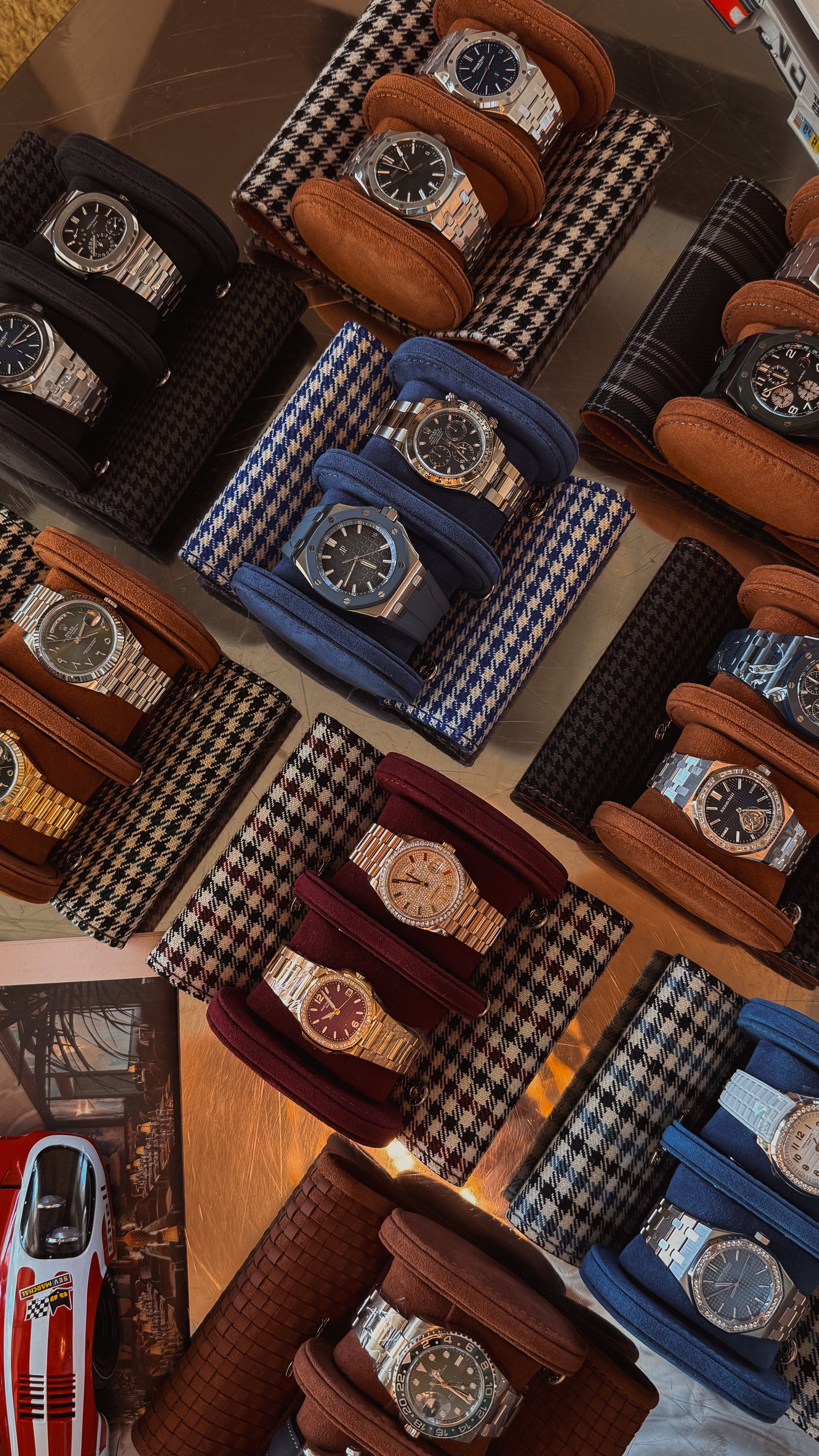
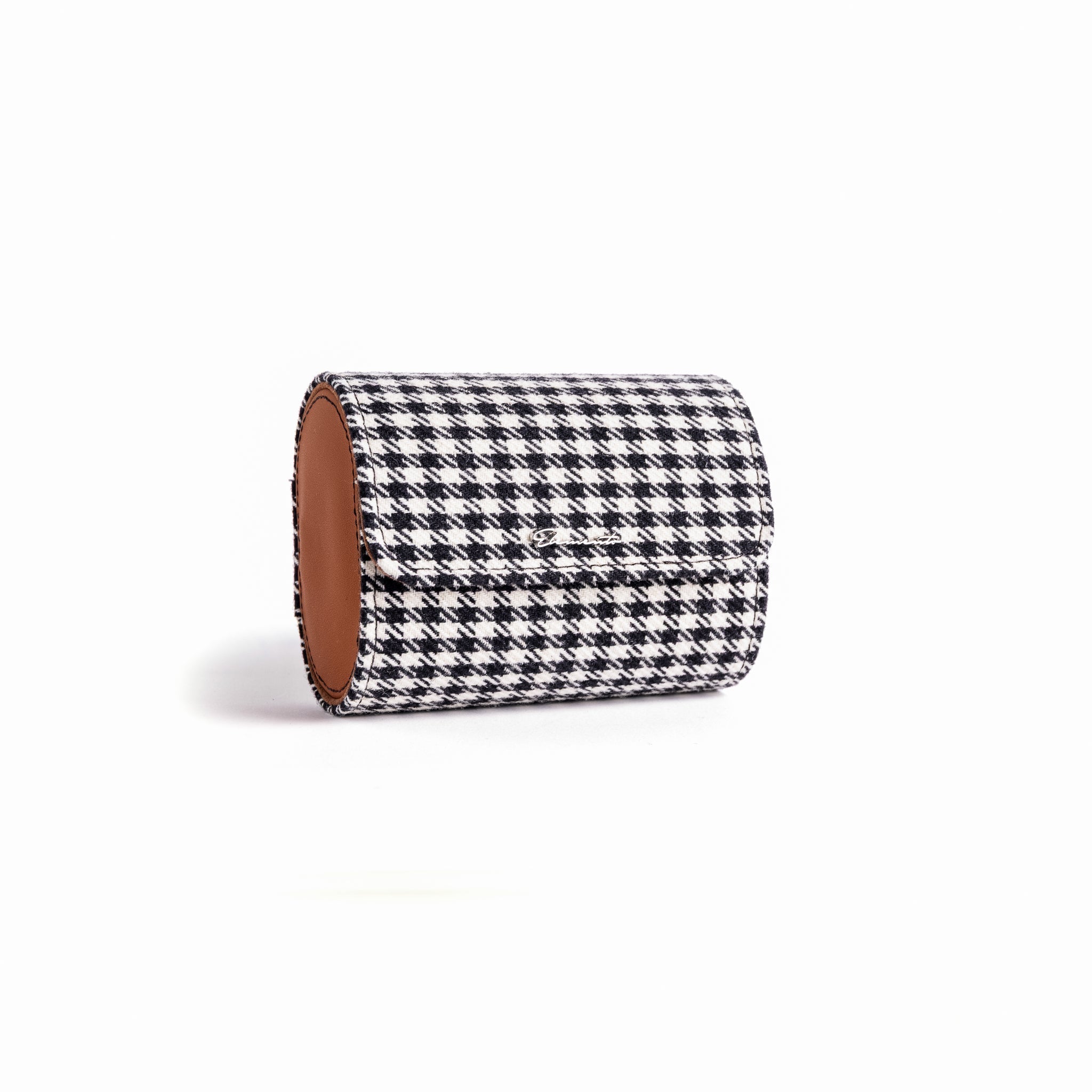
Our travel pieces are cut in Pepita — the dense houndstooth woven for European automotive interiors, and the reason most people recognise an Elemento object from across a room without being able to say why.
The choice is not decorative, or not only decorative. A textile of that construction was specified to survive several decades of sunlight through a windscreen, the friction of a person getting in and out of a seat several thousand times a year, and the accumulated body oils that come with all of it. Held to that standard, being carried in a bag is a holiday.
Practically, it means three things. The weave does not scuff, because there is no smooth surface to scuff. It does not show handling, because the two-tone tooth breaks up light before your eye can register a mark. And it does not crease, because it recovers — the roll you unwrap on the fourth morning looks like the roll you packed on the first.
We hold it in nine colourways, from the black-and-ivory that started the house to a burgundy and an olive that are considerably quieter than they sound. The tooth is the same in all of them; only the temperature changes.
The interior: Alcantara
The exterior is what people photograph. The interior is what decides whether the object was worth buying.
We line in Alcantara — a microfibre made at Nera Montoro in Umbria, developed in the early 1970s and now specified across automotive and aviation interiors for reasons that translate exactly to a watch roll.
It is matte, so it returns nothing to the eye and a dial laid against it is the only thing in the frame. It recovers rather than crushes, so a watch that has sat in the same compartment since March lifts out without leaving a permanent shadow. It holds a strap without gripping it — enough friction that nothing shifts in transit, little enough that nothing drags on the way out. And it resists the three things that finish an interior: abrasion, light, and the oils that come off skin.
It is also, quietly, the reason a roll is safe to close on a piece with a sharp-edged clasp. There is nothing in an Alcantara lining that will transfer to a case back, and nothing hard enough underneath it to press through.
How to use one properly
Three habits, and they take about four seconds each.
Close the clasp before the watch goes in. An open deployant is the single most common cause of damage inside a roll, and it is entirely self-inflicted.
Face the crystal inward. The case back has already lived a hard life. The crystal has not.
Do not overfill. A three-slot roll carries three watches. The fourth one — wedged in, because it is only one night — is how a seam is stretched and how two watches end up sharing a compartment for the length of a flight.
The part nobody says out loud
A watch roll is not really a protective object. It is a decision about how seriously you take the things you own.
Most collectors arrive at one the same way: they lose something small and irreversible, and they realise that the difference between a marked lug and an unmarked one was about four seconds of packing and a piece of cloth. The roll is not expensive relative to what it holds. It is close to free.
The only real question is whether you buy it before that lesson or after it.